THE IDITAROD
Fact, Not Fiction

Dr. John Bramante's pro-Iditarod response to April 1st story in ADN
Letter from Dr. Michael
Davis, who was NOT happy to discover his name and asthma research
was being used by race opponents. I think you'll find it interesting.
Margery Glickman is listed as a staff member of Animal's In Print, an on-line newsletter that openly supports Animal Liberation, which is characterized by groups like ALF, which uses bombs and intimidation to pursue it's goals.
As a teacher and dog lover, I'd enjoyed teaching Gary Paulsen's Woodsong (a work of FICTION, as is Winterdance) and a unit on the Iditarod race for some time before it was brought to my attention that the race was controversial. Surprised and a bit horrified, thinking that I'd possibly been indirectly supporting something abusive, I began to research the subject, reading everything I could put my hands on (reference list), talking to both race critics and supporters, as well as those who've attended and competed in the race, plus using my own common sense. Then, in March 2000, I made the journey to Alaska (at my own expense) to check out things firsthand, returning in the summer and again for Iditarod 2001. My conclusions? While the Iditarod may not be perfect, no sport is, it isnÆt the horror story its critics painted it to be, either. Others have done the same, including teachers Ann Morgan and Aarin Holmes. Attacked by activists prior to her trip, Morgan focused on their concerns and addresses them here as well as sharing a wealth of information. Second grade teacher Aarin Holmes followed in Morgan's wake in 2002, also reporting back on what she experienced, as have others, each making the trip independently with no ties to organizers.
This page, called The Iditarod: Fact, Not Fiction, might also be called ôAnswering the Critics,ö since it examines the most common charges against the race. Half-truths and vague accusations abounded, I found, but no one had seemed to take the time to look at the issue impartially, from all angles. This is my attempt to do so.
Unlike Margery Glickman, the raceÆs chief critic, however, I will not claim to have the truth and only the truth for, realist that I am, I feel the truth tends to lie somewhere in the middle. These dogs, wonderful athletes that they are, do get tired, do get sore and, occasionally, just like their human counterparts, come up limping or injured or even decide theyÆve had enough and quit. And, yes, like human athletes, they die.
Yet, as anyone whoÆs stood at the starting line with these dogs knows, watching them paw the ground and leap into the air in their excitement to be off, given the choice and knowing the possible consequences, they would choose to be exactly where they are, doing what theyÆre doing.
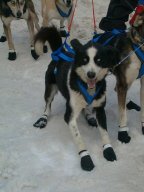
Sonny King's Buster, eager to be off
Assertion: "In Iditarod kennels, many dogs are permanently tethered on chains as short as four feet long. Tethering is cruel and inhumane."
Facts: Tethering, also called staking or tying out, is a time-honored practice not only among mushers, but dog owners in the Lower 48. It is also utilized by the US government, which maintains a kennel of sled dogs in Denali National Park. No one wants dogs to be tied up and forgotten but, unlike many backyard dogs, sled dogs are freed and given regular attention and exercise.
The length of chains used for tethering may indeed be as short as four feet, as stated, but most mushers use longer tie-outs. In the kennels I visited, the shorter lengths seemed to be reserved for dogs perhaps temporarily closer to high traffic areas, thus providing more security for both dogs and humans. Besides, it's also important to remember that a five or six-foot chain, on a swivel, gives a great deal of room to move. Think about it. Since the dogs body is frequently outside the chain, it is akin to the area of a minimum of 13x13 kennel with no wasted corner space. Say the circle is about 12.5' wide. That gives the dog nearly 123 sq. feet of space to run and play.
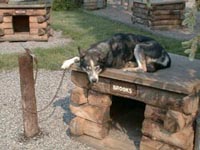
Brooks, a member of the US governmentÆs
sled dog team at Denali Park.
The actual length is immaterial, however, because like the sled dogs of Denali, the dogs are regularly taken off the chains and exercised. Many mushers, including four time champion Doug Swingley, who lives in Montana, allow some dogs to run free at times. In fact, current and four time champion Martin Buser was caught in the act of taking his dogs on a "free run" in USA Networks recent race telecast. Anyone familiar with dogs could easily tell both the wonderful bond between Buser and his dogs and that his was a frequent event in their lives, not something staged for the benefit of the camera. USA Network 's 2001 telecast caught several mushers, in fact, with free running dogs, however, all of them eager to be with and near their owners rather than cringing or attempting to flee. Of course, common sense tells anyone that letting too many dogs loose at once can result in unwanted pack behavior. Letting unsupervised dogs run loose, by the way, is a violation of local and borough leash laws in most areas of Alaska, not to mention elsewhere.
An owner of Siberian Huskies also points out that even when a dog is tethered it doesn't mean interaction isnÆt going on, whether with its humans or other dogs. The sled dogs' humans visit regularly. In fact, some actually move into the kennels for weeks at an time, and the chance to bond one-on-one with the dogs without another shoving its nose into the mix allows each dog its own bonding time. In addition, even when the humans are off doing human things, like buying dog food, dogs are social creatures and, given the opportunity, will organize a game, say, of "keep away," one dependent upon the dog using its native intelligence to figure out, say, just how far forward to push that stick towards its neighbor's nose while still keeping possession. I also ran across several such instances in the books I read and browsed, many of them focused on simply dogs in general, not just husky/sled dogs.
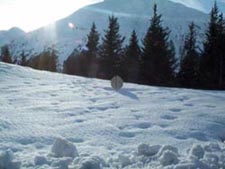
© 2001 Diane Nye, Iditarod Teacher on the Trail, 2001
Yes, that's a stop sign.
It might also be pointed out, since critics seem to occasionally miss the obvious, it snows, it snows a great deal in Alaska, snow that piles up inside kennels. As snow piles up, that 6' fence becomes shorter and shorter, allowing dogs to escape. Most huskies are master escape artists as it is, so snow only makes it easier.
Assertion: "In 1996, the United States Department of Agriculture said, 'Our experience in enforcing the Animal Welfare Act has led us to conclude that continuous confinement of dogs by a tether is inhumane.'"
 No, it didnÆt. Click the Star for the
full text of the USDAÆs Clarification.
No, it didnÆt. Click the Star for the
full text of the USDAÆs Clarification.
Facts: As noted in the link above, the Animal Welfare Act was aimed at federally licensed breeding kennels--particularly notorious "puppy farms" in the Lower 48 states. Some of these kennels were found to be permanently tethering breeding females, dogs who were given no exercise and often little attention. The law was never intended to apply to sled dog kennels, such as the governmentÆs own, where dogs are frequently removed from their tethers, are well exercised, and receive lots of individual attention and affection.
After the proposed amendment came out, its inaccuracies were brought to USDA's attention and the rule was officially changed. The USDA now acknowledges that tethering is humane and practical for most working dogs, a category that includes sled dogs. Those making this accusation know full well what the rule now says but persist in using the incorrect wording.
Assertion: "Continuous chaining psychologically damages dogs and makes many of them very aggressive animals."
Facts: I saw no signs that chaining psychologically damaged dogs. Yes, some are more shy than others but most seemed more socialized than the average dog. In fact, the biggest danger in most Iditarod dog lots seems to be the chance of getting licked to death by affectionate dogs. Chaining actually may promote interaction between humans and dogs and, in fact, might make dogs less aggressive since they cannot physically fight or interact. It's easier to approach and play or work with a dog on a chain, too, than one in a kennel by itself or with other dogs.
In addition, these dogs are literally surrounded by hundreds, maybe thousands of fans and dog lovers during the IditarodÆs start and restart. No hiding an aggressive, abused dog here. TheyÆre in clear view of fans and television cameras from around the world from the moment they arrive until long after they leave the starting line. In fact, one musher involved in the 2000 race recalled with a laugh being startled by a cameraman who appeared out of nowhere, in the middle of nowhere, during the race. So, thereÆs usually someone, somewhere, watching.
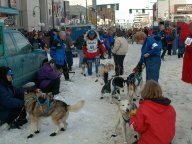
4th Avenue can get crowded
All teams in the race are subject to petting (and pestering) by everyone from well-meaning adults to trusting children, and no musher can realistically keep an aggressive, maladjusted dog. I saw fans, well meaning sponsors and handlers, not to mention media intent upon a story, approach dog after dog, sometimes literally stepping over the bemused animals, and the worst they got was a nudge asking them to pause and scratch an ear or back. Children clamored for ôhusky hugsö and returned them just as enthusiastically. No, thereÆs no room for maladjusted dogs here, so, if these dogs are the result of tethering, bring on the tethers.
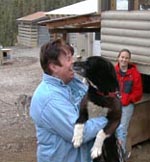
Cannon, a retired King lead dog.
Cannon is portrayed tethered on Ms. Glickman's page as an "abused dog."
Assertion: "A dog who is permanently tethered is forced to urinate and defecate where he sleeps, which conflicts with his natural instincts to eliminate away from his living area. Because the dog is always close to his own fecal material, he can easily catch deadly parasitical diseases by stepping in or sniffing his own waste."
Facts: First, this makes no sense. It is, however, a perfect example of the sort of circular logic you often encounter from race critics. How can an animal ôcatchö something from itself? True, IÆm not a vet but if the parasite is in its fecal matter, doesn't that mean it already has it? And, to follow this logic, isnÆt it therefore a good idea to keep the animals staked apart from each other and thus avoid any chance of transmitting disease?
Second and more importantly, "dog exhaust" is removed on a regular basis (which can't always be said of urban dwelling dog walkers, just ask any jogger), but even if it isn't, dogs have plenty of room to "take care of business" away from their houses. Although male dogs will mark their turf just as they would in the wild, dogs donÆt foul their own dens (or houses).
In addition, sled dogs, especially Iditarod dogs, are also vaccinated against just about everything that might affect them. They are wormed routinely and if they do get sick receive excellent medical attention. In any case, it would be instructive to remember that dogs have been happily eating (as well as sniffing and stepping in ) their own fecal matter for thousands of years and are still around. Indeed, one of the most basic instincts of a mother with pups is to lick her offspring clean of their wastes or to eat it directly, in order to keep the den as scent-free as possible. Anyone who follows any of the hundreds of email dog lists will see that this topic pops up frequently, so it is hardly rare or unique to Alaska.
Assertion: "Even if the fecal matter is picked up, the area where the dog can move about becomes hard-packed dirt that carries the stench of animal waste. The odor and the waste attract flies which bite the dog's ears, often causing bloody wounds and permanent tissue damage."
Facts: This just isn't the case. Again, remember, these dogs may cost thousands of dollars and most kennels are open to the public. In any case, many mushers use gravel, sand, or even wood chips. Besides, hard-packed dirt doesn't become unduly odorous. True, no one ever said dog lots were air-freshened living rooms, but they don't smell at all like many people think. In fact, one of the first things I noticed when I got out of the car at the first kennel I visited was the lack of any sort of distinctive odor and, to be honest, IÆd expected one. In addition, neither the odor nor insects were any bigger problem at these kennels than others IÆve seen elsewhere.
Assertion: "Dogs have died in the Iditarod from strangulation in towlines, internal hemorrhaging, liver injury, heart failure, pneumonia, 'sudden death', and 'exertional myopathy,' a condition in which a dog's muscles and organs deteriorate during extreme or prolonged exercise.
Facts: No one denies that dogs have died or been hurt in the Iditarod, but it goes without saying that no musher wants a dog to die or be hurt, nor do race fans. Not only does the musherÆs life depend upon the dogs' well-being, but most have raised these animals from puppies and consider them to be members of the family. In addition, rules provide for automatic disqualification of any musher who is found responsible for a dog's death (unless circumstances are beyond the musher's control), or one who abuses a dog under any conditions. Mushers are occasionally also withdrawn from competition by race officials, not because they're simply uncompetitive, as critics would have you think, but for the good of the entire team.
I might point out that three dogs died in a Chicago Walk in the Park fund raiser in a matter of hours, a topic ignored by Ms. Glickman and other critics, I might add.
True, the Iditarod is not a walk in the park. On the other hand, the dogs are bred for it, trained for it, and based on my observations, seem to thoroughly enjoy running it. Countless hours of video have been shot by countless sources, along countless twists and turns on the trail, all showing the same thing, dogs eager and happy to run. If they weren't, they wouldn't be on teams headed for Nome, where no camera has yet captured a dog collapsing as it crosses the finish line. They have, however, caught dogs running past the finish line, forcing their exhausted musher to hustle to stop them.
Similarly, had critics made the trip to Anchorage last year to check their facts in person, they could have taken just a few steps outside the Millennium Hotel and seen how un-exhausted some dogs were who'd recently completed the Yukon Quest. Although many consider the Quest tougher than the Iditarod, there were many of the same dogs who'd travelled that trail with 2001 Yukon Quest Champion Tim Osmar, barking, leaping, rearing up on their hind legs, eager to be off for a run. The dogs were shiny, healthy, and happy, hardly what one would expect of abused, exhausted dogs. This was all caught on video camera, by the way, easily proven. Yet, hmmm, not one doubter was there, just as none have ever seen a dog cross the finish line and collapse simply because it hasn't happened (Musher Dick Mackey did collapse as HE crossed the line, I might note, tho' his dogs were ready to keep on going).
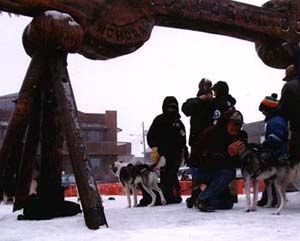
© Karen Ramstead
Tired? Hardly. The dog in front is barking
and raising a ruckus, hardly likely for a
totally exhausted dog after crossing the finish line.
As three time Iditarod champion Jeff King has said, you can't push a rope, and if the dogs decide not to pull, well, that musher isn't going anywhere. Just ask DeeDee Jonrowe, whose hopes were crushed in the 1999 race when her veteran team of dogs stopped and made it clear they'd had enough. The same thing happened to others in Iditarod 2000, with several teams simply stopping and declining to move one step closer to Nome, despite the musherÆs best entreaties, a rebellion that earned the dogs a plane ride home, not sudden death.
In any case,as much as I hate statistics, the death and injury rate for Iditarod dogs is far, far lower than for a comparable number of "civilian" dogs during the same time period. True, while any death is to be regretted, there is no comparison to the number of unwanted dogs put down "humanely" in animal shelters across the country. In fact, an article in the Huntsville newspaper stated that 10 million dogs and cats are put to sleep every year. ThatÆs approximately 27,397 per day. Allow a 50-50 split between cats and dogs and you have 13,698 dogs that are put to sleep per day, every day. Is it any wonder that I feel the constant barrage of emails demanding we focus our attentions on this race, a race in which one dog has died over a 9+ day event in both of the last two years, is an example of misplaced passion?
To that point, I've had it pointed out to me several times by those active in rescue, that the race's chief critic remains silent and inactive when urged to partake in rescue or fostering of dogs, hence giving lie to her own cries of doing whatever it takes to end abuse, even when the very dogs she claims to care so much for, the husky, are the dogs in question. Recently, as my own involvement in this area increased, I got the same response, none, to various posts requesting help with huskies in need.
Ironically, many of those whoÆve at least made an effort to give dogs unwanted by others a second chance have been attacked recently as unfeeling, abusive owners when, in fact, after exhausting all resources, theyÆve simply had to admit defeat and turn dogs in to shelters or have them put to sleep because they had no other choice. No one, I repeat, no one likes this scenario but, well, reality has a way of intruding on even the most optimistic, even PETA. In the summer of 2000. AP reporter Matt Barakat reported that PETA had euthanized 1,325 animals, a figure PETA president Ingrid Newkirk verified in an email published in countless animal rights email lists. ôIt is a totally rotten business but sometimes the only kind option for some animals is to put them to sleep forever,ö said Newkirk. Ironically, when an outcry came from within and without PETA ranks, Newkirk simply listed PETAÆs accomplishments, citing them as enough to excuse this deviation from what many assumed was a PETA goal of no animal deaths.
Update: Read more about PETA and the number of animals they've killed, not helped here
In any case, as to the how and why Iditarod dogs have died or been injured, the causes are essentially no different from those which commonly afflict any active dogs or other animals, or even humans. Huge strides have been made in the past decade toward minimizing the risk to Iditarod dogs, and the numbers support this. When race critics cite statistics, however, they chose to ignore the statistical proof of how the care of these dogs has improved, using old figures, figures calculated including deaths from a time when the race was admittedly relatively unmonitored, to back up their claims. In fact, as independent reports have shown, much of the research on Iditarod dogs has had positive impacts on the rest of the veterinary world, and many non-Iditarod dogs are much better off because of these accomplishments.
Assertion: "The Iditarod Trail Committee provides inadequate veterinary care during the race."
Facts: This charge is absurd. In fact, itÆs one of the few that actually angers me. First, critics charge that there aren't enough vets, then they insinuate that the vets involved are somehow involved in some conspiracy to hide abuse simply because they've taken the time to educate themselves on the special needs of these working dogs as opposed to those of backyard animals. My own vet, when asked, said she would be of limited effectiveness at the race because she doesn't have the specialized knowledge required, which these volunteer vets have acquired, usually at their own expense. In other words, this is much the same as an injured athlete having the choice between a general practioner and a sports medicine specialist. If you were in his or her shoes, which would you choose? Yeah, me, too. The specialist.
In fact, the medical care given Iditarod dogs is arguably among the best in the world. In the months before the race, dogs are given two comprehensive blood tests, an electrocardiogram, and a thorough physical examination. Dogs with problems are treated as required or not allowed to run. Dogs are monitored constantly and I stood on 4th Avenue and watched vets literally give every dog involved in the race, almost 1,300, one last, hands on check before the start of the 2000 race, ensuring their identity via a microchip.

Rick Swenson's Troy,
A product of the skill and dedication of the Iditarod vet crew
During the race, veterinary support provided by the International Sled Dog Veterinary Medical Association (ISDVMA) is superb. ISDVMA vets, bottom line, are the very best in their profession, and those who work the Iditarod are chosen in a highly competitive process from a worldwide pool of volunteers. As noted above, critics hint that membership in this organization makes them somehow less than worthy when, in fact, it makes them better suited. It takes unique skills and knowledge to care for these incredible athletes, just as it takes special doctors to care for human athletes, and they come with knowledge and skills the ordinary vet has not acquired.
Critics claim there isnÆt a vet at each checkpoint. TheyÆre right. Race policy is to have at least three vets at every checkpoint, often more, and to ensure that every dog, in every team, will get a hands-on physical examination at every checkpoint if possible. Remember, as the race spreads out, it is unlikely that more than a small number of dogs will be at each checkpoint at any given time, hence the ratio of dogs to vets is irrelevant, and as the race progresses, the number of vets available will also increase since all will be moving forward with the teams. In any case, questionable dogs can be pulled from the race by vets, although this rarely happens because mushers work very closely with the vets and will drop dogs long before problems can get out of hand. In fact, anyone who wanted to check the health of most of these dogs had only to wander into the Regal Hotel and look out the window of the lounge as, far from being hidden, during the early part of the race, dropped dogs were kept and cared for right behind the hotel, in clear sight of one and all.

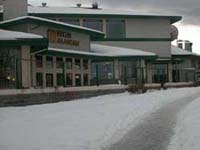
Dropped dog and view of the hotel from the dog drop area.
When I asked chief race vet Stu Nelson how it was possible to check each and every dog, he gave me an acronym to explain the basic steps taken. The acronym is HAWL. ôHö stands for heart and hydration, something of the utmost importance to both musher and vet. The vets specifically check for elevated heart rates (greater than 120bpm at rest) and abnormal rhythms (arrhythmias). It has been noted that most sled dots have a heart rate of less than 100 beats per minute. That's fit, very fit, as house dogs normally have a heart rate of about 120. In any case, the heart aspect of this acronym is obvious but, if one bothers to read any of the many books written about the race, one will inevitably encounter a mention of a musher doing what is might be called the ôsnap backö test to check a dogÆs hydration. Basically, they pull the skin between the dogsÆ shoulders up and watch to see if it ôsnapsö back into place quickly. The speed with which it does this is a good indication of the hydration level.
ôAö stands for appetite and attitude, two more important ingredients for success. Bottom line, what the vet is looking for here is to see if the dog is not only eating but having a positive race. Good attitude makes for a happy, healthy dog, so itÆs high on the list of things to check for, even as simplistic as IÆve made it sound. ôWö is for weight, which might be seen as a logical partner of ôhydrationö and ôappetite,ö but not always. If an animal is eating well, has a good appetite, but has difficulty keeping on weight, itÆs going to be losing strength as the race progresses, meaning more time and attention will have to be paid it by the musher during both runs and rests. These dogs might even have to be coaxed to eat or drink, meaning more care must be taken.
Finally, ôLö is for ôlungs.ö Is the dog having trouble breathing? Are there any obvious obstructions in the air passages? Are there any signs of impending disease or problems? Again, this brief explanation makes this sound rather simplistic but the techniques used have been effective. Probably the most common reason for dropping a dog is some sort of limp, a visual sign, so a method of determining other, less visible signs is a valuable tool to the vet core.
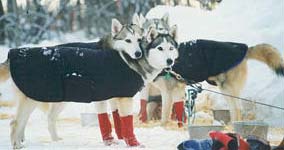
© 2001, Julie Verrette
Dog coats are now a part of the stylish Iditarod dog's wardrobe.
Click here to read an unsolicited letter I received. In it, the writer describes what he observed as he viewed Iditarod vets caring for dogs during a race.

IN MEMORY OF DON BOWERS
Thanks for being a friend and teacher to so many, Don.
SDAC Director Margery Glickman also frequently charges that mushers shoot "many dogs" when they return disabled. This is sheer nonsense and shows a complete lack of understanding about the bond between a musher and his or her dogs. Troy, pictured earlier, is a perfect example of this as he remains a loved, valued member of Rick Swenson's kennel. It was this sort of bond that first drew me, as a dog lover, to read Paulsen's Woodsong, the FICTION book now used in so many classrooms as the basis for teaching interdisciplinary units that focus on the Iditarod. Most mushers have any number of retired Iditarod dogs, kept as valued companions after their running days are done.
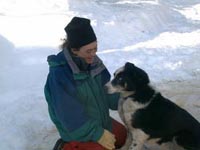
Retired 15 year old sled dog
In fact, while visiting dog lots in March, I saw any number of ôgrandmaö and ôgrandpaö dogs roaming the area, some of whom have declined to become couch potato dogs inside, while others have taken to that life with gusto.
The same holds true for the charges of "culling." First, accusers show ignorance by not understanding the true meaning of culling as used by knowledgeable dog people. Culling isn't killing, it's simply separating out the most likely for specialized training and/or care.
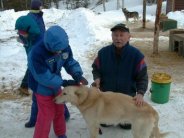
Argie, the "CULL," with friends
Ironically, one musher portrayed in a recent documentary was accused of culling when, in fact, the very fact she and her older, near retirement lead dog were in the program gives lie to that accusation. Why? Because the dog featured was a cull, a fact his owners have openly stated. Thus, it's important to know and understand the specialized vocabulary of those involved in dog breeding and handling before jumping to assumptions.
Assertion: "In the Iditarod dogs are forced to race approximately 1,150 miles from Anchorage to Nome, Alaska, about the distance between LA and Denver in 9 to 14 days. Mushers claim the dogs love to run, because they are distantly related to wolves. However, in nature wolves never run so far and so fast."
Facts: To say that dogs are "forced" to run the Iditarod is fantasy. As I've pointed out elsewhere, there is no way to force an individual dog to run, much less an entire team. One of the most prized attributes of these dogs is their independence, even when it brings you to a crushing standstill in the middle of nowhere. Again, just ask DeeDee Jonrowe.
Besides, the dogs do not run this entire distance non-stop. I sometimes think this is perhaps what some people think. Far from it. The ratio of run to rest is usually equal or more in favor of rest, so this argument makes little sense.
Even more importantly, they donÆt actually ôrunö the entire time. They trot or even walk. One breathtaking moment recorded in my mind in March was of passing a team trotting along, in perfect sync, along a highway leading to Knik.
Whether they are related to wolves has nothing whatever to do with the issue, although I do have an interesting article that was sent to me about wolves doing this very thing. Despite this, I'm not even sure why critics tossed this issue into the argument. Bottom line, if the dogs did not want to run--regardless of their ancestry--there would be no Iditarod or even anything resembling distance mushing.

© 2001 Diane Nye, Iditarod Teacher on the Trail, 2001
Self-harnessing model?
Determined to be part of the action, Hannah Moderow's dog concentrates on harnessing itself.
Tell me again that this dog doesn't wanna run.
Assertion: "Sports columnist Jon Saraceno wrote in the Sports Section of USA Today on March 3, 1999 that the Iditarod should be called the 'Ihurtadog' calling it a 'travesty of grueling proportions,' 'an embarrassment, 'and an outrage that should be banned in its present form.'"
Facts: First, Jon Saraceno's column is an opinion column, not a news column. In other words, it isn't based on facts, purely one man's opinion. However, since I was aware that Saraceno was on site for a race, I thought perhaps he might have more credibility than the critics. Yet, when I wrote USA Today, which covers the Iditarod, I might note, to inquire about this article, the editor took great pains to point out that Mr. Saraceno's column was an opinion column and in no way reflected the opinions of the newspaper.
I later discovered that Mr. Saraceno left the hotel for slightly less than an hour his entire visit, hardly time to investigate anything. In any case, I have discovered, Saraceno is a longtime and self-avowed critic of the race who has apparently, given the editor's oblique response that "it was an opinion article" when asked if facts had been verified, never taken the time to verify his claims. In fact, some of his peers accuse him of opposing the race simply to gain publicity.
In any case, Saraceno seems to be in a very small minority. For every negative article or story you find, you can usually find dozens of positive, soundly researched articles. I would also like to add that Mr. Saraceno has never bothered to reply in person to letters in regards to his charges, asking for the proof to support his charges.
At first, this didn't bother me. Ironically, Ms. Glickman herself then fueled my own suspicions of Saraceno's intent, suggesting that PBS's failure to respond quickly to her questions of their involvement with the Iditarod Trail Committee (no support was given) during filming of a Nature special was suspicious and indicated some lack of truthfulness. Thus, using her own logic, I guess I should be extremely suspicious of Mr. Saraceno's veracity. To date, 2007, I have never received a response.
This tactic, ignoring all who question their charges, I've found, to be a common one among animal rights activists, yet I would urge all who read this to make a point of researching both sides of the issue. Anyone who claims to have all the facts and the only facts is a fool. Margery Glickman, perhaps the best known race critic, routinely publishes her address, so I feel no qualms at urging you to contact her for info against the race.
Again, it is only when you look at both sides of an issue that you can come to an intelligent, balanced decision.
Assertion: More recently, such critics have accused the Iditarod Trail Committee of, basically, conspiracy to hide the truth about any dog death's during the race. The implication is that there are many, many such deaths, all hidden from the media or with the assistance of the media.
Facts:Given the intense media attention this race garners, I find it hard to believe any dog death could be hidden, let alone multiple deaths. In 1999, there was one death, its aftermath caught on film in the PBS special Sled Dogs, it's male musher bent over in tears. There was also only one death in 2000 and 2001, with another dog dying in 2001 of an unrelated problem soon after being dropped and returned to its home kennel. This was confirmed by a non-Iditarod affiliated vet, as all dog deaths are. Thus, far from hiding the death of these dogs, the ITC has been open about it from the beginning until the final published report. All dog deaths are reported on the Iditarod's web site within hours of the event. Before you criticize the time lag, please understand that info must occassionally come in from the trail via ham radios and, as a result, can take some time in transmission.
So, upon the death of any animal, there is a press release which is not only sent to the media, (many of whom are out on the trail and thus on the scene as well) but posted on the ITC website. A second press release is issued after the gross necropsy has been performed by a board certified veterinary pathologist who gives a preliminary cause of death and sends tissue samples to several independent laboratories. I would like to emphasize the word INDEPENDENT. In no way is the lab that makes the final determination associated with the race, a fact most critics prefer to ignore.
A report is issued to the Iditarod board of directors when the results of these tests are received. This may take several months and is available to the press upon request from the ITC. These findings are not usually sent out as a press release because, quite frankly, once the race is over, since most interested media have had people on the spot whoÆve researched and covered the topic in person, theyÆre often no longer interested in what is old news to them. Their lack of attention to the matter, however, cannot be held against the Iditarod Trail Committee. If youÆd like to read a copy of the Rodman report, which the ITC sent me, no questions asked, please email me and IÆll be happy to send you a copy. I haven't made a point to get the reports for all dog deaths, I have to admit, but know that all it will take is a phone call to Iditarod Headquarters to get one.
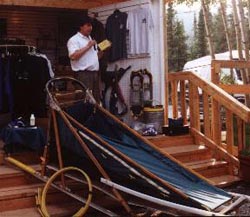
Ramy Brooks explains use of vet book to listeners at a presentation near Denali Park.
To restate the veterinarian care given to these dogs: The ITC takes measures to make this the safest animal participation sport possible. There are up to 4-5 veterinarians at every checkpoint. Since the mushers are moving up the trail, these veterinarians are hopped up the trail. There is a total force of from 33-36, plus the chief veterinarian.
At least one veterinarian remains in the checkpoint until every team has passed that point and all of the dropped (yes, they can and often do leave a dog at a checkpoint if it is tired, injured or just doesn't want to go on) dogs are taken for air transport back to Anchorage or Nome, depending upon where they are dropped. That veterinarian then also moves up trail. Thus, as the race progresses, there are additional vets in place then to deal with any emergencies. In addition, there are strict rules regarding dog care and each musher carries his "vet" book which is filled out by veterinarians along the way with observations on his team so that other vets up the trail can see what has been going on and if a dog needs to be watched.
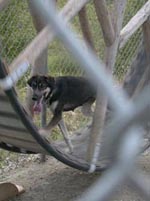
Running, by choice, not force
Assertion: Some dogs are tethered to exercise wheels as part of their pre-race training. Because the dogs run at varying speeds, the slower runners are pulled along by the neck, which causes injuries. Dogs who are tired or ill are forced to run. The number of injuries from the exercise wheel goes unreported.
Fact: I can state without hesitation that there is no truth to this charge. In fact, although IÆd often mouthed the ôhuskies love to runö mantra, I never quite understood just how much until I got to Martin BuserÆs and saw a mother dog running happily along on an exercise wheel with nary a human in sight. She wasnÆt tethered to the wheel in any way, shape, or fashion and, in fact, ignored all efforts by visitors to call her off the wheel to visit. During my entire visit, I only saw her hop off the wheel once, to nuzzle her puppies and sip the readily available water, then she hopped right back on the wheel and was still loping along happily when I left. IÆm not sure quite what it is that makes these dogs run but I will never again doubt their love and drive to run.
UPDATE: Oh, my, can I attest to the "huskies love to run" mantra. I am now the owner of a retired Iditarod sled dog, one that made her way to Nome twice, and she has been an eye-opener to the difference between a genuine sled dog and one that, in the paragraph above, I thought was like a sled dog. I'll be happy to hand you Hazy's leash anytime and let you set off down the driveway for a walk with her if you doubt the power of these animals. Ha
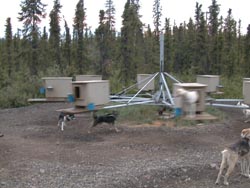
This is my day to be musher!
One of Jeff KingÆs dogs gives lie to charges of dogs being dragged
by ôexercise wheelsö as it takes a ride on his carousel,
which can be shut off with the flip of a switch
or a whistle from King halting the dogs,
not to mention by auto switch if a problem is sensed.
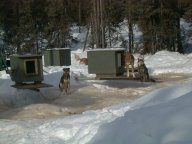
The same is true of Dee Dee Jonrowe's wheel, seen here in the winter. In
fact, Jonrowe doesn't use it for anything more nowadays than what you
see, dog houses.
What Ms. Glickman calls an exercise wheel is actually a carousel. Contrary to her charges, any dog not wanting to run simply hops on itÆs ôfront porchö and rides while the dogs wanting to run do just that. The white dog pictured above cracked me up, in fact, with itÆs bored expression as it rode round and round, not to mention the yawn it gave its human and myself as the carousel came to a halt and it settled in once again for a nap. On the other hand, while she rode, a retired dog, running free in the yard, opted to run with the rest, only in the opposite direction. Again, the pure independence of these dogs is amazing.
Please see Sunhusky's Iditarod Den, Facts and Links, for more. You might also find some quite revealing info at Jeff King: The Man & His Dogs.
Mrs. Morgan's Iditarod Adventure is another excellent site. Attacked by activists prior to her trip, Morgan, a teacher, focused on their concerns and addresses them here as well as sharing a wealth of information. Second grade teacher Aarin Holmes followed in Morgan's wake in 2002, also reporting back on what she experienced, as have others who will be linked her ASAP.
Finally, Janet Oates, of the Alaska Service Area branch of the Providian Health System, was kind enough to allow me to share the letter she sent in response to my inquiry into reasons for their continued involvement with the race.
Last updated: Feb. 18, 2007.
© 2001-2005, June Price.
Do not use photos or material without written permission.
UPDATE: It was recently brought to my attention that Margery Glickman had accused me of perpetuating lies and spreading disinformation on the internet because I've written some articles for the Iditarod. Personally, I had to laugh. Here is my very public response to Margery: "ROFLMAO....Oh, Margery, as always you crack me up. I know good and well you know better. Anyone who knows anything about the Iditarod period, let alone the true meaning of a volunteer organization knows you aren't going to get rich doing anything for the Iditarod. Go broke maybe, get rich never."


Running Husky, Courtesy of Colors of the Siberian Husky
